Medicaid Eligibility & Benefits: Coverage, Requirements & How to Apply
Medicaid is a joint federal and state health coverage program that helps eligible people access medical care at little or no cost. It serves qualifying low-income adults, children, pregnant women, seniors, and people with disabilities across the United States.
Eligibility requirements and covered services vary by state. Medicaid participation can also help establish eligibility for the federal Lifeline program, which offers discounts on qualifying phone or internet services.
This guide explains who may qualify for Medicaid, what benefits are available, how to apply, and how Medicaid connects to other assistance programs.
For a broader overview of tablet assistance, explore our free government tablet information.
What Is Medicaid and How Does It Work?
Medicaid provides health coverage to eligible individuals through programs administered by state governments under federal requirements.
Each state determines certain eligibility rules, covered services, and program procedures within federal guidelines.
Unlike private health insurance, many Medicaid beneficiaries pay little or nothing for covered healthcare services, although some enrollees may face permitted premiums or copayments.
Medicaid vs. Medicare vs. CHIP
| Program | Main purpose | Who it serves |
|---|---|---|
| Medicaid | Free or low-cost health coverage | Eligible low-income individuals and other qualifying groups |
| Medicare | Federal health insurance | Primarily adults 65+ and certain younger people with qualifying conditions |
| CHIP | Children’s health coverage | Eligible children in families meeting state requirements |
Some individuals qualify for both Medicare and Medicaid, known as dual eligibility.
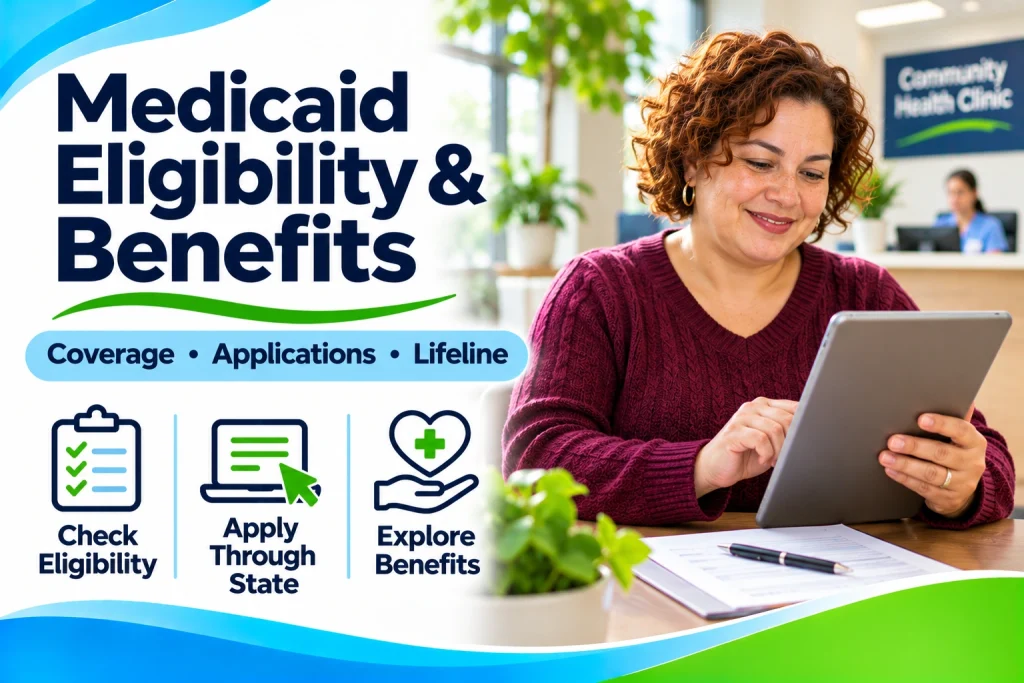
Who Qualifies for Medicaid Benefits?
Medicaid eligibility depends on several factors, including household income, state residency, family circumstances, age, disability status, and applicable citizenship or immigration requirements.
Medicaid for Low-Income Adults
In states that expanded Medicaid under the Affordable Care Act, many qualifying adults under age 65 can receive coverage based primarily on income.
The expansion income threshold is commonly described as approximately 138% of the Federal Poverty Level, reflecting the applicable income calculation rules.
However, not every state has expanded Medicaid, and eligibility rules are not identical nationwide.
Medicaid for Pregnant Women and Children
Pregnant women and children may qualify under different income limits than other adults.
Some children who do not qualify for Medicaid may be eligible for the Children’s Health Insurance Program (CHIP).
Medicaid for Seniors and People with Disabilities
Certain older adults and people with disabilities may qualify through additional eligibility pathways.
These pathways can include rules involving income, resources, disability status, and long-term care needs.
Important: Meeting one eligibility factor does not automatically guarantee approval. The state Medicaid agency makes the final determination.
For official guidance, visit Medicaid.gov — Eligibility Policy.
Medicaid Income Requirements
There is no single Medicaid income limit that applies to every applicant in every state.
Eligibility thresholds may differ based on:
- State of residence
- Household size and income
- Age and pregnancy status
- Disability or long-term care needs
- Medicaid expansion status
- The specific coverage category
For many adults, income eligibility uses Modified Adjusted Gross Income (MAGI). Different financial rules can apply to certain aged, blind, disabled, or long-term care applicants.
Helpful tip: If you are unsure whether your income is too high, submit an official application rather than assuming you are ineligible.
What Benefits Does Medicaid Cover?
Medicaid covers a broad range of healthcare services, but exact benefits depend on the state’s program and the beneficiary’s coverage category.
| Healthcare benefit | General coverage information |
|---|---|
| Doctor visits | Physician services are a mandatory Medicaid benefit |
| Hospital care | Inpatient and outpatient hospital services are mandatory |
| Laboratory and X-ray services | Included among mandatory benefits |
| Preventive services | Covered according to applicable federal and state requirements |
| Prescription medications | Outpatient prescription coverage is provided by state programs, subject to rules |
| Dental and vision services | Availability and coverage vary by state and eligibility group |
| Long-term care | Available to eligible individuals under applicable requirements |
| Medical transportation | Transportation assistance is required under applicable Medicaid rules |
Children eligible for Medicaid have additional protections through the Early and Periodic Screening, Diagnostic, and Treatment (EPSDT) benefit.
Applicants should review their state’s benefit information before assuming that a particular treatment, device, or service is covered.
How to Apply for Medicaid
Medicaid applications are accepted throughout the year. You do not need to wait for the annual Health Insurance Marketplace open enrollment period.
Step 1: Find Your State Medicaid Program
Start with your state’s official Medicaid agency or the Health Insurance Marketplace.
Step 2: Complete Your Application
Provide the requested household, income, residency, and other eligibility information.
Step 3: Submit Verification Documents
Your state may request additional documentation when necessary.
Examples can include proof of income, identity, residency, or other information relevant to your eligibility category.
Step 4: Review Your Eligibility Decision
Your state will determine whether you qualify and explain the next steps.
Step 5: Complete Enrollment Requirements
Depending on your state, you may need to select a managed care plan or primary care provider.
Official application resource: USAGov — How to Apply for Medicaid and CHIP.
What If Your Medicaid Application Is Denied?
A denial does not necessarily mean you have no health coverage options.
Review the state’s decision notice to understand the reason.
Possible next steps include:
- Correcting missing or inaccurate information
- Submitting requested supporting documents
- Requesting an appeal or fair hearing within the applicable deadline
- Checking eligibility for CHIP or Marketplace coverage
- Reapplying when your circumstances change
If you lose Medicaid because you no longer qualify, you may be eligible for a special enrollment period through the Health Insurance Marketplace.
Medicaid Renewal and Changes to Eligibility
Medicaid beneficiaries must continue meeting applicable eligibility requirements.
States periodically review eligibility and may request updated information.
Important for 2027: New federal Medicaid community-engagement requirements are scheduled to affect certain adults in Medicaid expansion coverage beginning in 2027, subject to applicable implementation rules and exceptions.
Not every Medicaid recipient will be subject to these requirements.
Review notices from your state Medicaid agency and respond to requests for updated information by the stated deadlines.
Does Medicaid Qualify You for Lifeline?
Yes. Medicaid participation is one of the recognized eligibility routes for the federal Lifeline program.
Lifeline provides monthly discounts on qualifying phone or internet service to eligible households.
Applicants whose Medicaid participation cannot be verified automatically may need additional documentation.
Can Medicaid Help You Get a Free Government Phone?
Some participating Lifeline companies advertise free or discounted smartphones under separate promotions.
However, Medicaid does not directly provide a standard free government phone benefit.
Explore our Free Phone with Medicaid guide for provider offers and application information.
Can Medicaid Help You Get a Free Tablet?
Medicaid participation may establish eligibility for Lifeline, but it does not guarantee a free tablet.
Separate provider promotions, nonprofit programs, and certain healthcare-related device assistance options may have their own requirements.
Read our Free Tablet with Medicaid guide for available options.
Can Medicaid Recipients Get Discounted Internet?
Medicaid may qualify a household for Lifeline and certain provider-specific internet affordability programs.
Our Affordable Internet for Low-Income Families guide explains how to compare those offers.
Frequently Asked Questions
What is the income limit for Medicaid?
Medicaid income limits depend on your state, household size, and eligibility category. In expansion states, many qualifying adults use a threshold commonly described as approximately 138% of the Federal Poverty Level.
Can I apply for Medicaid online?
Yes. You can generally apply through an official state Medicaid portal or the Health Insurance Marketplace.
Can adults receive Medicaid without children?
Yes. Many states provide Medicaid expansion coverage to qualifying adults without dependent children.
Can I qualify for both Medicaid and Medicare?
Yes. Some eligible individuals receive both programs, with Medicaid potentially helping cover certain Medicare-related costs and services.
Does Medicaid cover dental and vision care?
Coverage varies by state, age, and eligibility category. Check your state plan for the applicable benefits.
Is Medicaid the same as SNAP or EBT?
No. Medicaid provides health coverage, while SNAP provides food assistance. Some people qualify for both programs.
Does Medicaid provide free phones or tablets?
Not as a standard Medicaid benefit. Medicaid participation can establish Lifeline eligibility, while device offers are separate.
Can I receive Lifeline without SNAP if I have Medicaid?
Yes. Medicaid independently qualifies as an approved Lifeline eligibility route, subject to the program’s other requirements.
Can I apply for Medicaid at any time?
Yes. Medicaid and CHIP applications are accepted throughout the year.
Final Thoughts
Medicaid provides essential healthcare coverage for eligible individuals and families, but requirements and benefits vary across states.
Start by checking your state’s official eligibility rules, applying through an authorized channel, and reviewing your coverage options.
If you qualify for Medicaid, you may also be able to access separate assistance programs such as